39
Built-in hammer
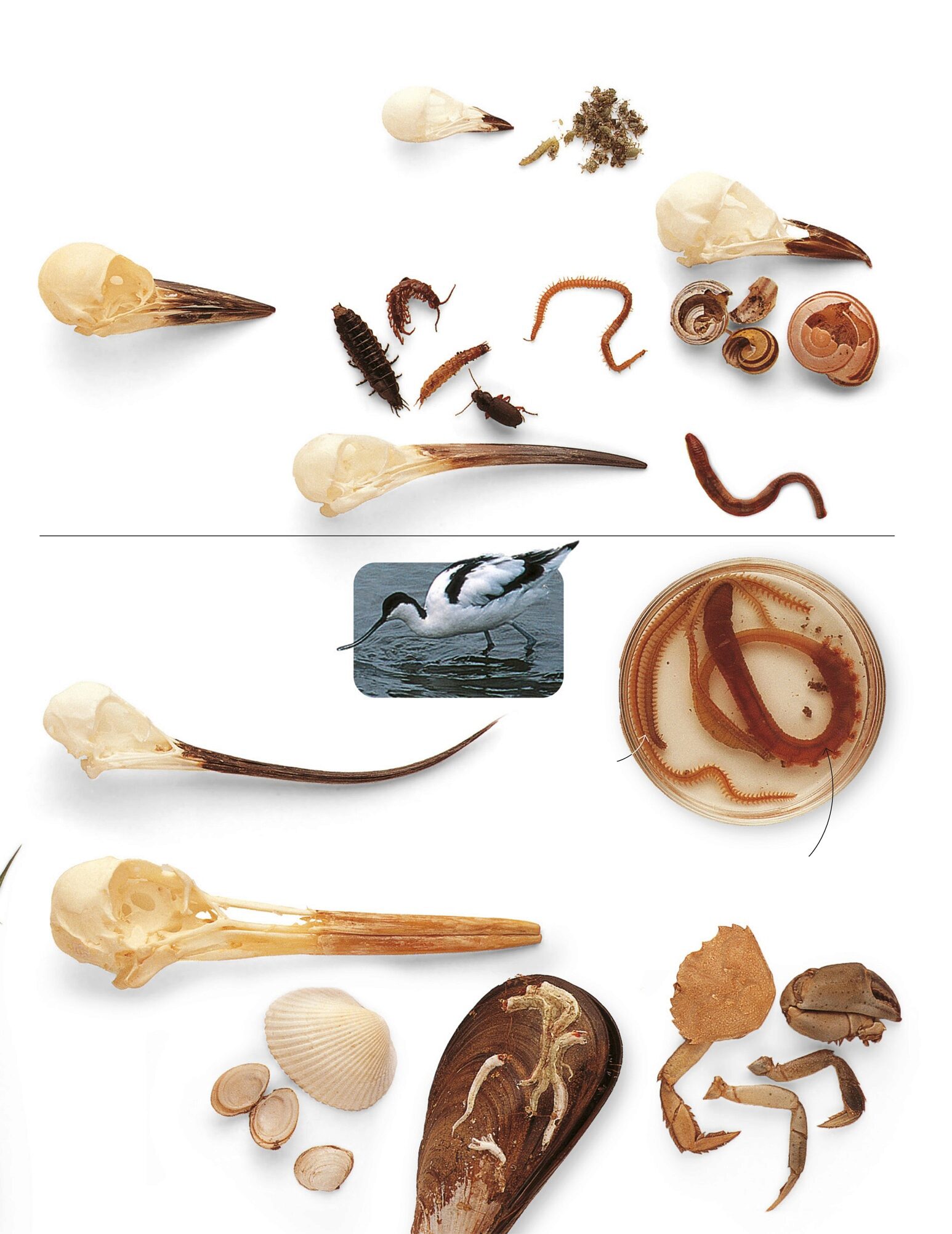
The oystercatcher
feeds on seashore
animals with hard
shells such as mussels.
Its long beak ends in
a blunt tip that allows
the bird to smash
through shells.
The sweep-net beak
The avocet catches worms and other
prey by striding forward and sweeping
its upturned beak from side to side.
Feeding on the shore
Invertebrates that birds eat are plentiful
on the shoreline, and range from crabs
and shellfish to burrowing worms.
Earthworms are eaten by
garden birds, and also
by some birds of prey.
Snail
shells
Thrush skull
The snail-smasher
Thrushes eat a wide range of
food – both plant and animal.
Some feed on snails, which they
smash open on stones.
Blackcap skullAphids
Caterpillar
Probing warblers
Warblers use their probing beaks
to pick insects from leaves and bark.
Invertebrate-eaters
Many birds alter their diet throughout the year
and eat whatever food is available. The number of
insects and other invertebrates – animals without
backbones – increases dramatically in spring,
whereas in winter, food is scarcer and consists
mainly of larvae (grubs) in wood or in the soil.
Woodpecker
skull
Large insect-eaters
The hoopoe uses its beak to pick
large insects out of tree crevices,
while the woodpecker chisels
into the wood to find hidden
grubs. Their long tongues have
spear-like tips, which are used
for impaling their prey.
Beetle
larvae
Centipede
Adult
beetle
Hoopoe skull
Cockles
Oystercatcher skull
Mussel
The crab’s hard
skeleton is left
uneaten by an
oystercatcher.
Worms
Avocet feeding
Ribbonworm
Silt-burrowing lugworm
Avocet skull